Free Printable Hexagon Graph Paper
Choose a hexagon size and orientation to print honeycomb graph paper for chemistry, games and design.
Ready-to-print hexagon paper PDFs
Want a one-click download? These PDFs use the preset settings, with a 10 mm margin, and print at actual size.
About hexagon paper
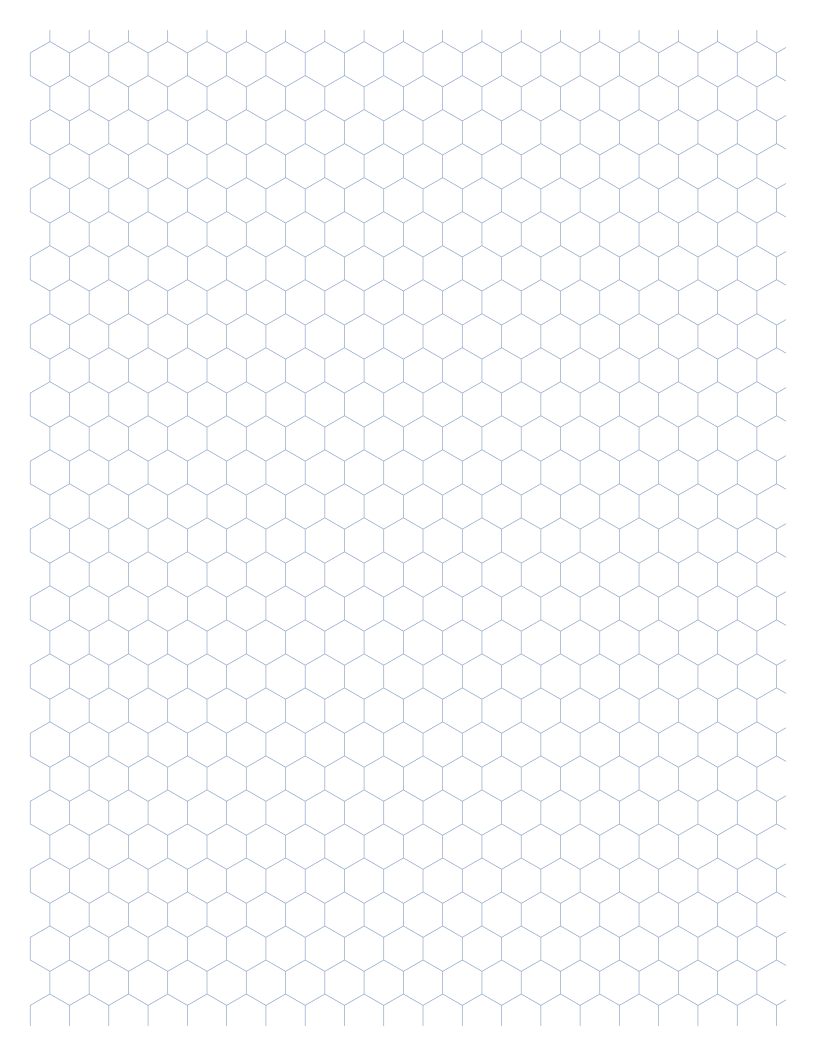
Hexagon paper covers the page in a honeycomb of regular six-sided cells. Each cell has six equal neighbours, which makes it the natural grid for drawing ring-shaped molecules, building tabletop and role-playing maps, and designing tessellated patterns.
Set the side length from 3 mm to 40 mm. Small cells suit detailed chemical structures, while large cells work for maps where each hex is a territory. Pointy-top orientation has a vertex at the top of every cell, and flat-top has a flat edge on top with the cells lining up in columns.
Partial cells at the page edge are trimmed cleanly at the margin, so the honeycomb fills the printable area neatly.
What you can use it for
- Organic chemistry: benzene rings and carbon structures
- Tabletop and role-playing game maps
- Quilting, mosaic and tile design
- Maths: tessellation and geometry
- Prototyping hex-based strategy games
The options explained
- Hexagon side length. Length of each of the six sides. Smaller values give more cells per page.
- Orientation. Pointy top or flat top. Many hex-map games use flat-top, and chemistry diagrams often use pointy-top.
- Line thickness. Thin lines suit small cells. Use thicker lines for large map hexes.
- Line color. Soft colours let your drawing stand out. Use a darker line if you will photocopy the page.
Printing tips
- For game maps, print on heavier paper (120 gsm or more) and choose a hex size that lets your tokens fit comfortably.
- For chemistry notes, 6 mm hexagons leave room for labels at each vertex.
- Landscape orientation often fits map-style content better than portrait.
For more detail, read the guide to printing paper at home.
Frequently asked questions
What are the two hexagon grid orientations?
Pointy-top hexagons have a vertex at the top and interlock in horizontal rows. Flat-top hexagons have a flat top edge and interlock in columns.
What size hexagon suits a game map?
For miniatures or tokens, 20 to 30 mm hexes work well. For a small dungeon or an overview map, 10 to 12 mm is usually enough.
Can I use hexagon paper for chemistry?
Yes. Use the Small preset with pointy-top hexagons, then draw benzene rings and fused ring systems directly on the grid.
Why are the hexagons at the edge cut off?
The grid is clipped at your page margin so the printed area is neat. Increase the margin or change the size if you prefer whole hexagons.