Free Printable Isometric Graph Paper
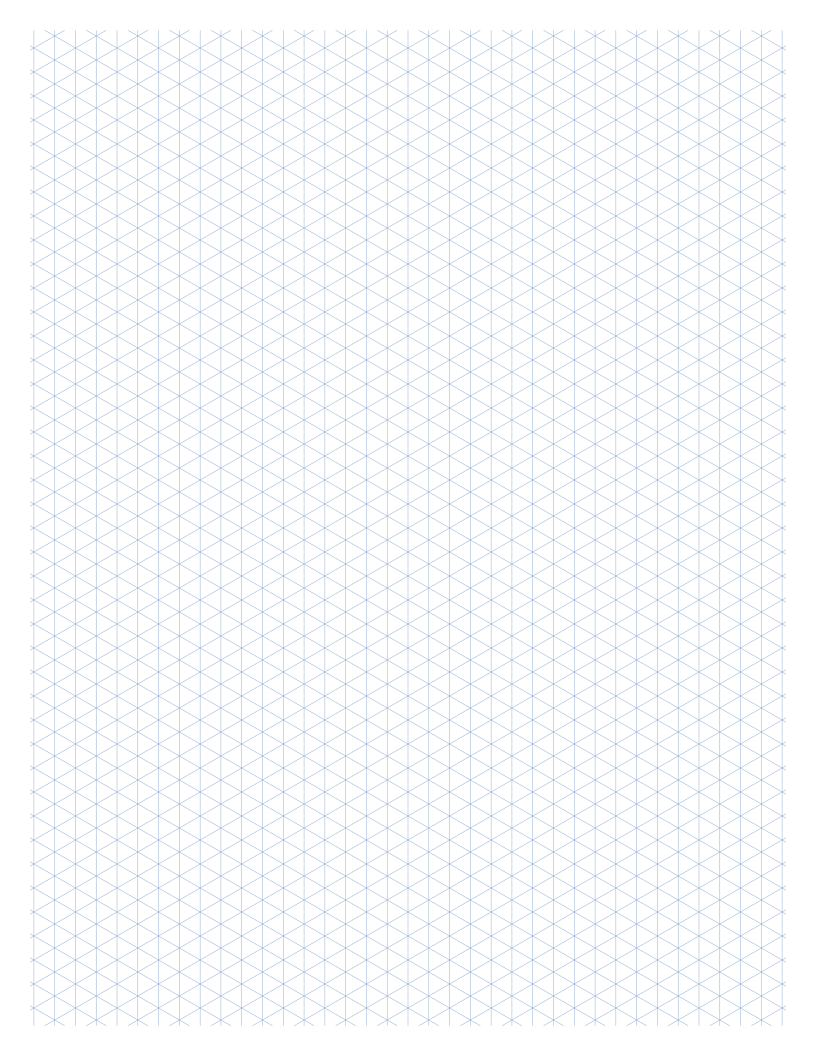
Draw cubes, boxes and 3D sketches on an isometric grid. Choose lines or dots, set the triangle size and print.
Ready-to-print isometric paper PDFs
Want a one-click download? These PDFs use the preset settings, with a 10 mm margin, and print at actual size.
About isometric paper
Isometric paper is built from equilateral triangles. The lines run vertically and at 30 degrees either side of horizontal, which lets you draw three-dimensional objects such as cubes, shelves and machine parts with every edge at its true length and no perspective.
Pick lines for a traditional grid, or dots for a lighter look that is easier to sketch over. Vertical orientation is the standard setting for 3D drawing. Horizontal orientation turns the grid on its side, giving horizontal lines and 60 degree diagonals, which suits tessellation and pattern work.
The triangle side length is yours to set, from 2.5 mm up to 40 mm.
What you can use it for
- Isometric drawing and technical illustration
- Designing pixel-art style game assets
- Architecture and interior layout sketches
- Origami and tessellation patterns
- Teaching geometry and spatial reasoning
The options explained
- Triangle side length. Length of each triangle edge. 6.35 mm (1/4 in) is a good all-round size.
- Style. Lines draw the full triangle grid. Dots mark only the intersections.
- Line direction. Vertical lines is the standard for 3D drawing. Horizontal lines rotates the grid by 90 degrees.
- Line or dot size. Thickness of the lines or diameter of the dots, in points.
- Color. Soft blue-grey is easy to draw over. Choose a darker colour if you will photocopy the page.
Printing tips
- Draw vertical edges straight up and down, and the other two directions along the grid diagonals.
- Use dots when you want to draw in pen without the grid showing through.
- Start with larger triangles if you are new to isometric drawing and move to a finer grid as your sketches get more detailed.
For more detail, read the guide to printing paper at home.
Frequently asked questions
What is isometric paper used for?
It is used to draw 3D objects on a flat sheet with equal scale on all three axes: engineering sketches, product concepts, game art and puzzles.
What is the difference between isometric lines and dots?
Both give the same structure. Lines draw every triangle edge, while dots only mark the corners, so the page is lighter.
Why do the lines run vertically instead of horizontally?
In a standard isometric drawing the vertical edges of an object stay vertical and the other two axes sit at 30 degrees from horizontal. Vertical orientation matches that. Switch to horizontal if you need the rotated pattern.
Which paper sizes are available?
Letter and A4 plus Legal, Tabloid, A3, A5, A6 and Half Letter, in portrait or landscape.